In Memoriam: Beppe (Giuseppe) Cavatorta (1964-2026)
It is with profound sadness that we remember our dear friend and colleague, Beppe (Giuseppe) Cavatorta. Beppe was a presence unlike any other, whether serving as President of the AATI, Chief Reader for the AP Italian Language and Culture Exam, Professor of Italian at the University of Arizona, or as the non-conforming poet extraordinaire that so many of us came to know and love.
Throughout his distinguished career, Beppe made significant contributions to Italian Studies as a scholar, teacher, translator, editor, poet, and mentor. His work shaped the field in countless ways, and his dedication to Italian language and culture touched generations of students and educators. While others will speak more fully about the breadth of his scholarly accomplishments and professional achievements, I would like to reflect on the qualities that made him such a special member of our community and such an important presence in the lives of so many colleagues.
I first met Beppe during my time as the New York State Regional Representative for the AATI. I will admit that I was initially puzzled by both his appearance and demeanor. He seemed so different from many of the professors I had previously encountered. What I quickly came to learn, however, was that Beppe embodied those qualities we value most as educators and colleagues. He was inclusive, accepting, generous, and deeply committed to helping others succeed. More importantly, he taught not by telling, but by showing. He modeled through his actions the very values we strive to instill in our students and bring to our profession.
I speak from experience when I say that Beppe had a remarkable ability to see what people were capable of, even when they could not yet see it themselves. He gave me my first significant responsibility within the AATI Executive Council when he asked me to co-chair the newly formed advocacy committee. Looking back, it is doubtful that I would be writing to you today as the Association's President had Beppe not entrusted me with that opportunity. From that moment, nearly a decade ago, I came to see him not only as a colleague and friend, but also as a mentor.
I know my experience was not unique. Over the years, many of us sought Beppe's advice, guidance, and perspective when faced with challenging decisions or uncertain situations. He had a way of offering wisdom without imposing it, encouraging without directing, and supporting without seeking recognition. Some of my favorite conversations with Beppe, however, had nothing to do with organizational matters. Often, they centered on language itself. I would occasionally send him a text asking about an Italian word, expression, or nuance of meaning, knowing that he would appreciate the question and likely have a thoughtful answer. This past summer, we exchanged messages about the proper name for the small knob that sits atop a Sicilian brioche (un bernoccolo, secondo Beppe). Months later, completely out of the blue, he texted me a video about that very knob. I still don't know whether he had been searching for it all that time or simply came across it and remembered our exchange. Whatever the case, it speaks volumes about the kind of teacher Beppe was. He never stopped being curious, and he never stopped teaching. For him, conversations were never truly finished; they simply continued, often months later, in a new form. The dialogue was continual, and the learning was always ongoing.
One of Beppe's lasting contributions to the AATI was his commitment to building a more inclusive organization. Before such conversations became commonplace, he understood the importance of ensuring that K-12 educators felt welcomed, valued, and represented within our Association. He actively sought their perspectives, promoted their involvement in leadership and committee work, and helped create opportunities for meaningful engagement across educational levels. His efforts strengthened the ties between K-12 and higher education and helped shape the AATI into a broader and more representative community of Italian educators.
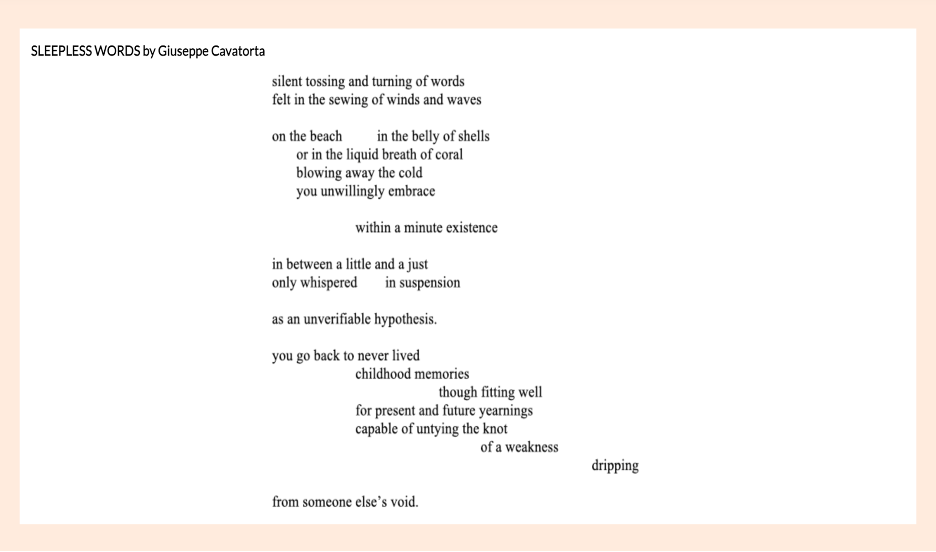
Words, quite naturally, were one of Beppe's greatest gifts. His publications, translations, and poetry testify to his extraordinary talent. Yet what I will remember most are the personalized poems and songs he created during the AP Italian Readings. Those fortunate enough to participate know exactly what I mean. Throughout the reading, Beppe quietly observed, listened, and took mental notes. Then, on the final evening, he would unveil his original writings that somehow managed to include everyone present. Clever, thoughtful, and often hilarious, these creations celebrated not only the individual personalities in the room but also the sense of community we had built together. They transformed a demanding two weeks of work into something more meaningful, reminding us that we were not merely colleagues completing a professional task, but friends who had become a kind of family. I am saddened to know there will be no new poems or songs in the years ahead, but I am grateful to have been part of the few I had the privilege to experience.
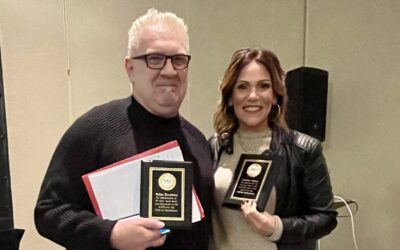
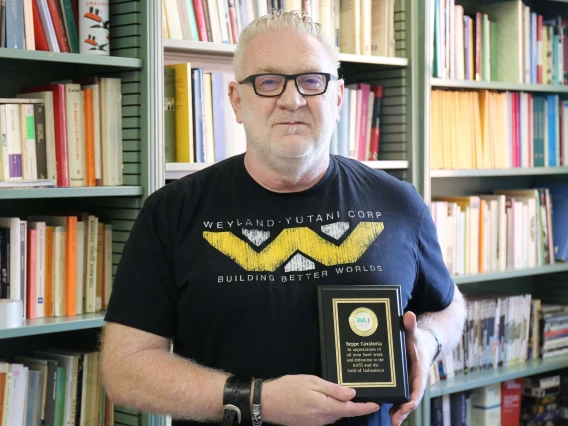
In 2024, the AATI recognized Beppe's extraordinary contributions by awarding him the Distinguished Service Award in the College/University Division. The award acknowledged his years of leadership, mentorship, advocacy, and service to both the Association and the broader field of Italian Studies. Looking back, I am especially grateful that we had the opportunity to celebrate him in this way while he was still with us. The award formally recognized what so many members already knew: that Beppe's influence extended far beyond any title he held. Through his generosity, vision, and unwavering support of others, he helped shape the organization we know today.
As I have reflected on Beppe's life and legacy, I have heard from many of you. One colleague, in particular, asked me to remember to mention one of Beppe's most remarkable qualities: his ability to reveal who he was through everything he did, without ever making himself the center of attention. He expressed himself through the way he taught, led, collaborated, mentored, and created. In many ways, he managed to speak about himself without ever saying the word “I”. The opportunities he created for others, the communities he helped build, and the friendships he nurtured revealed far more about his character than any self-description ever could.
Ironically, especially during large Executive Council meetings or AP gatherings, Beppe was often a man of few words. But when he spoke, people listened. His comments were thoughtful, measured, and frequently exactly what needed to be said. Perhaps that was because he spent far more time listening than speaking.
As we mourn Beppe's passing, we also celebrate a life that enriched the AATI, the AP Italian community, and the broader world of Italian Studies. The AATI Executive Council is already exploring ways to honor his memory and celebrate his enduring contributions to our profession. We look forward to sharing those plans with members in the coming months.
We will miss him deeply. We are grateful for his friendship, his mentorship, his example, and the community he helped create. His legacy lives on in the countless students, teachers, scholars, and colleagues whose lives he touched, encouraged, and inspired.
M. Marina Melita, President, AATI
Beppe, the Poet Laureate of the AATI
I cannot recall when I first met Beppe Cavatorta, in part because it seems he has always been part of my formation. We surely first became acquainted through the AATI, most likely when I became Director of Communication and he was serving as Regional Representative for the Plains-Southwest. Beppe soon became a fixture of the AATI landscape. He attended all the AATI@ACTFL conferences, and he insisted on bringing the annual conference back stateside at a time of year when K-12 instructors could attend. That vision came true at Marist College in May 2019. AATI@Marist was a great success. It opened the door for many K-12 colleagues who had rarely been able to join us, and it started a trend of hosting the AATI National Conference in the United States once again.
If I had to name the thread that ran through everything Beppe did, it would be the word, la parola. He lived with words in three registers at once. There was the creative word of the poet and translator. There was the scholarly word of the critic. And there was the pedagogical word of the teacher who knew that a language is built one word at a time. That is why, to so many of us, he was and will remain our poet, our captain.
Some of my earliest memories of Beppe come from our work together on the Development Committee of the AP Italian Language and Culture Examination. The committee's charge is to write, edit, and produce the annual examination. Beppe could spend what felt like hours arguing for this word rather than that one. The rest of us would join in, racking our brains for a synonym or a new way to build the question so we could avoid “X” issue. At the time, those debates could feel endless. Looking back, I see them as small lessons in what Beppe believed most deeply. For Beppe, words had innate meaning. They were never interchangeable, never mere placeholders. Each one carried a weight, a history, and a responsibility to the student who would one day read it.
Beppe's CV is rich with research. He translated the works of roughly fifty authors, most of them poets, in publications across North America and Italy, as well as three book-length projects. He published some thirty articles in peer-reviewed journals. These focused mainly on poetry, but also on the sacred, on narration and the novel, on experimental writing, and on pedagogy. He wrote four book chapters and ten introductions and afterwords, and he edited or co-edited ten volumes. He wrote the monograph Scrivere contro. Viaggio nella narrativa sperimentale italiana del XX secolo. He co-authored three Italian textbooks and the large OER project Italian in Wonderland, supported by an NEH grant. In his last years, Beppe expanded his creative voice, once again showing his passion for the word. In 2020 he published two poetry collections, Istantanee di un amor de lonh and La stanza sgombra. Over his career, he was invited to give keynotes or invited lectures at least thirty times. Whether he was carrying a poet's line from one language into another, tracing the breaks and ruptures of twentieth-century experimental fiction, or setting down verses of his own, Beppe treated every word as something to be weighed, honored, and carried across. In him, the translator, the critic, and the poet were one and the same reader, devoted to the word.
Beppe and his colleagues at the University of Arizona worked tirelessly on the Italian in Wonderland OER project. In short, it is an open textbook covering the elementary and intermediate Italian sequence. He created this innovative, interactive book to ease the burden of overpriced textbooks and to give more students access to the study of Italian. When you page through Italian in Wonderland, you quickly see Beppe's love for the word and his understanding of how words build a language. Here, the poet's attentiveness becomes the teacher's gift. Vocabulary is never a list to memorize. Each word is a doorway, carefully chosen and placed in context, inviting students to step through the looking glass into Italian and its culture. By making the book free, Beppe also made a statement about words themselves: they belong to everyone, and access to a language should never depend on the ability to pay for it.
Beppe served the American Association of Teachers of Italian for many years. He was Plains-Southwest Representative (2015–2017), President (2018–2020), and Past President (2021–2023). He also served as Book/Media Review Editor for Italica (2014–2017). Beyond the AATI, Beppe was a cornerstone of the AP Italian Program. He served on the Development Committee and as an AP Consultant, and he held every leadership position within the AP Reading, including two terms as Chief Reader (2012–2016; 2022–2024). In each of these roles, Beppe was a steward of words. As a review editor, he read the words of colleagues with rigor and generosity. As President, he chose his words to bring a community together. As Chief Reader, he guided hundreds of Readers through thousands of student essays, insisting that every response, even an imperfect sentence written by a seventeen-year-old, deserved to be read carefully, fairly, and with respect. He understood that behind each student's words was a learner taking a risk in a new language, and he honored that risk. He spent his free time and creative energy during the Reading to pen both a poem and song that incorporated our collective experience; his words celebrate the individuals and the annual experience. His words would bring us together during our final evening, a send off until next year.
Beppe was also, for so many of us, a mentor, though he would likely have chosen a more modest word. I count myself among them; as I said at the outset, he has always seemed part of my formation. His mentoring, too, was made of words. He offered the encouraging word to a graduate student unsure of her voice, and the candid word to a junior colleague who needed to hear it. He wrote countless letters of support, reread drafts with a pencil always in hand, and could reframe a problem with a single, carefully chosen sentence. He never told you what to think. Instead, he asked the question that sent you back to the text, to the poem, to the right word. Many of us still hear his voice when we revise a paragraph or hesitate over a synonym: Is this really the word you mean? In that sense, Beppe's mentorship continues. It lives in the sentences we write, the classes we teach, and the students we now mentor in turn, passing on the words he gave us.
The creative word, the scholarly word, the pedagogical word, the mentoring word: for Beppe, these were never separate vocations, but four voices of a single passion. The title of his first collection recalls the troubadour's amor de lonh, a love from afar. Now that is how we must love him. La stanza sgombra, the emptied room, names an absence we all feel today. Yet the room is not silent. It holds his translations and essays, his poems and textbooks, and the exam questions he labored over. It holds the margins he filled with questions and the letters he wrote on behalf of others. Above all, it holds the students and colleagues he mentored, who learned from him that the right word matters and who now pass that lesson on. Those words remain, and through them, so does Beppe.
Ciao, Cavatorta. Grazie per ogni parola.
Ryan Calabretta-Sajder, Past President, AATI